Plan a 450 m² room from anywhere.
A curator abroad needs the gallery as it really is: the open floor, the movable walls and the true size of every print and frame.
Instytut Fotografii Fort, known as IFF and in English as the Fort Photography Institute, is an independent foundation in Warsaw devoted to photography. Its gallery, reading room, education programme and shop share one conviction: that photography is a vital tool for reflecting on the contemporary world.
Cloudly Culture works with IFF on exhibition planning. Vernissage, our curator workspace, was developed around IFF’s gallery and the practical needs of its curators.
Visit fiff.org.pl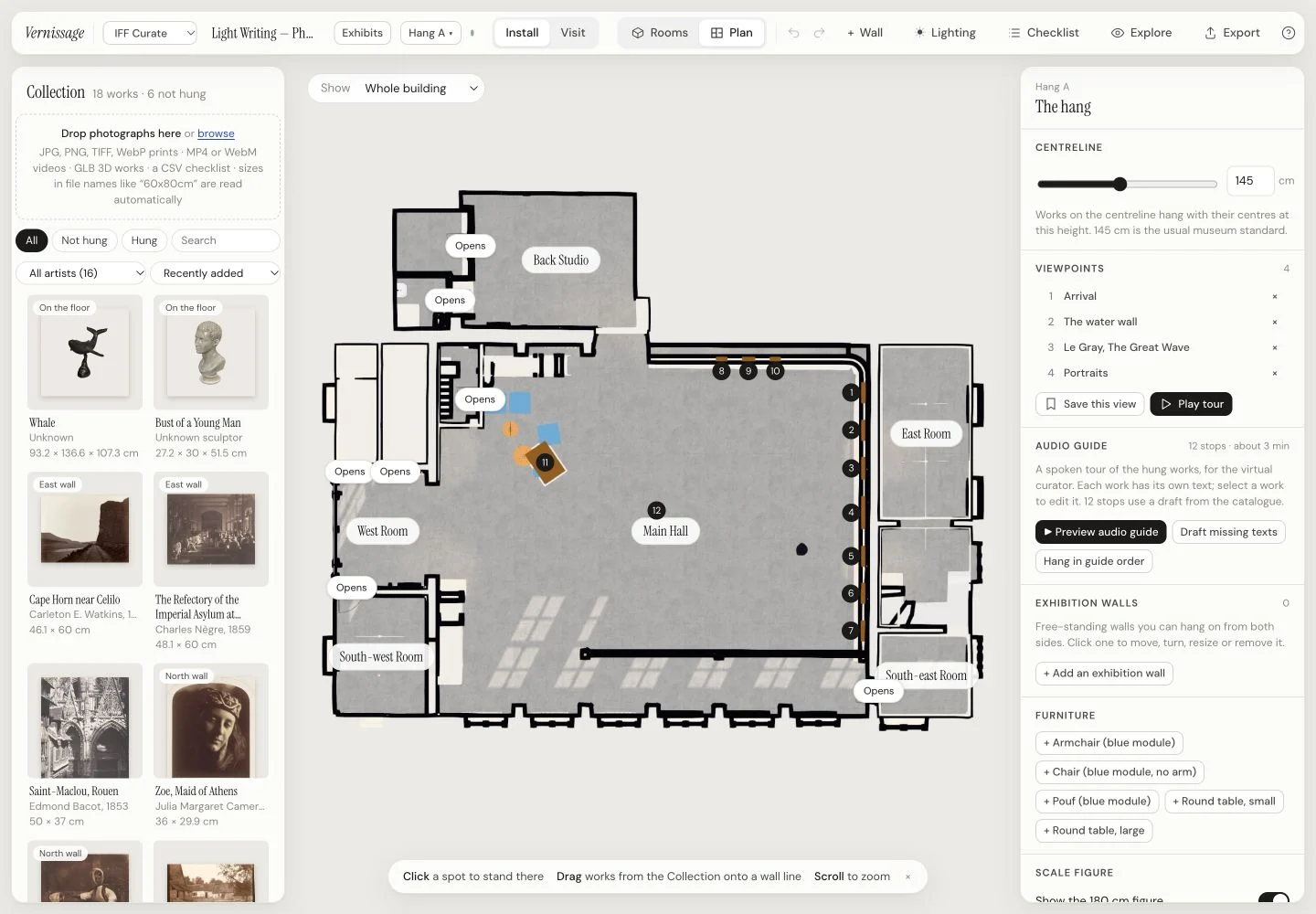
The foundation was initiated by Bernard Kwapiński, a photographer, promoter and collector of photography who owns one of the largest collections of photography books in Poland. IFF’s own account records Olga Łacna founding the foundation in Warsaw in 2015; she led it as President and Programme Director until the end of 2022, producing and co-curating more than 25 exhibitions focused on Central European identity.
Since 2016 IFF has been based at Fort Mokotów, a green, post-industrial site that was once part of the Warsaw Fortress and later a broadcasting station for Polish Radio. In 2018 the board established a pro bono Programme Council to shape the institution’s long-term programme and education.
Today the foundation is chaired by Katarzyna Białousz and Justyna Kociszewska, supported by the Foundation Council and the Programme Council, with White Stone Development as patron.
IFF gives photography a home that is generous in every sense: a large, flexible gallery, a free library anyone can use and an education programme that runs from matchbox pinhole cameras for children to masterclasses for professionals, with photographers such as Rob Hornstra and Simon Norfolk.
It is independent, built on community involvement and on the support of people and organisations who believe in art and education. And its programme looks outwards, placing Polish and Central and Eastern European stories in conversation with artists from abroad.
Its curators and advisers include photographers, editors, historians and festival makers whose careers span Polish and international institutions. That depth of expertise is exactly why we wanted to build our planning tools with them.
IFF shows artists from Poland and abroad, plans its programme at least 18 months in advance and also produces exhibitions for other institutions. That means curators, artists and partners are often in different cities or countries while the decisions about the room are being made.
Each exhibition gets its own scenography in an open space with movable walls, so no two hangs are alike. Curators need to test layouts at real scale, check sightlines and share one reliable plan with everyone involved, without everyone standing in Fort Mokotów.
That is what Vernissage is for. It holds a real-scale model of the IFF gallery where works can be hung, walls moved and versions compared, then exported as wall elevations, checklists and portable exhibition files. The same space can later welcome online visitors.
Planning tools & export formatsA curator abroad needs the gallery as it really is: the open floor, the movable walls and the true size of every print and frame.
Where the first image is seen from the door, how a sequence reads along a wall, what a temporary wall hides or reveals.
Artists, curators, the IFF team and partner institutions work across time zones. Everyone needs the same version of the hang.
Scaled wall elevations, checklists and positions for the team installing the show, long before the works arrive.
The IFF space in Vernissage currently shows a clearly labelled demonstration collection; it is not a published IFF exhibition.
An international foundation for interdisciplinary research on mummies and human remains, established in 2024.
GALLERY PRACTICEvan den Berg Galeria SztukiA Warsaw gallery opened at Emilii Plater 12 in 2012, now returning with two virtual exhibition spaces.
ONLINE EXHIBITIONSVan den Berg Fine Art GalleryThe gallery of painter and pianist Riaan van den Berg at Vaal Marina, South Africa, and the online exhibition A Life in Colour.
We work with institutions, galleries and researchers who want to give culture more room. Tell us about the space, the collection or the story you are preparing.
info@cloudlyculture.com